
Cost of Quality (COQ)
Quality Glossary Definition: Cost of quality
Cost of quality (COQ) is defined as a methodology that allows an organization to determine the extent to which its resources are used for activities that prevent poor quality, that appraise the quality of the organization’s products or services, and that result from internal and external failures. Having such information allows an organization to determine the potential savings to be gained by implementing process improvements.
- Prevention costs
- Appraisal costs
- Cost of poor quality (COPQ)
- Internal failure costs
- External failure costs
- COQ and organizational objectives
- COQ resources
Prevention costs
Prevention costs are incurred to prevent or avoid quality problems. These costs are associated with the design, implementation, and maintenance of the quality management system. They are planned and incurred before actual operation, and they could include:
- Product or service requirements: Establishment of specifications for incoming materials, processes, finished products, and services
- Quality planning: Creation of plans for quality, reliability, operations, production, and inspection
- Quality assurance: Creation and maintenance of the quality system
- Training: Development, preparation, and maintenance of programs
Appraisal costs
Appraisal costs are associated with measuring and monitoring activities related to quality. These costs are associated with the suppliers’ and customers’ evaluation of purchased materials, processes, products, and services to ensure that they conform to specifications. They could include:
- Verification: Checking of incoming material, process setup, and products against agreed specifications
- Quality audits: Confirmation that the quality system is functioning correctly
- Supplier rating: Assessment and approval of suppliers of products and services
What is Cost of Poor Quality (COPQ)?
Cost of poor quality (COPQ) is defined as the costs associated with providing poor quality products or services.
- Internal failure costs are costs associated with defects found before the customer receives the product or service.
- External failure costs are costs associated with defects found after the customer receives the product or service.
Internal failure costs
Internal failure costs are incurred to remedy defects discovered before the product or service is delivered to the customer. These costs occur when the results of work fail to reach design quality standards and are detected before they are transferred to the customer. They could include:
- Waste: Performance of unnecessary work or holding of stock as a result of errors, poor organization, or communication
- Scrap: Defective product or material that cannot be repaired, used, or sold
- Rework or rectification: Correction of defective material or errors
- Failure analysis: Activity required to establish the causes of internal product or service failure
External failure costs
External failure costs are incurred to remedy defects discovered by customers. These costs occur when products or services that fail to reach design quality standards are not detected until after transfer to the customer. They could include:
- Repairs and servicing: Of both returned products and those in the field
- Warranty claims: Failed products that are replaced or services that are re-performed under a guarantee
- Complaints: All work and costs associated with handling and servicing customers’ complaints
- Returns: Handling and investigation of rejected or recalled products, including transport costs
Cost of quality and organizational objectives
The costs of doing a quality job, conducting quality improvements, and achieving goals must be carefully managed so that the long-term effect of quality on the organization is a desirable one. These costs must be a true measure of the quality effort, and they are best determined from an analysis of the costs of quality. Such an analysis provides a method of assessing the effectiveness of the management of quality and a means of determining problem areas, opportunities, savings, and action priorities.
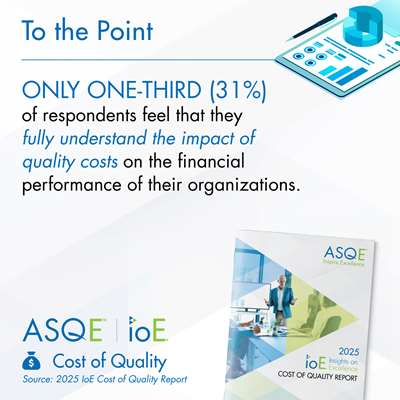
However, doing this effectively requires resources and dedication. According to the 2025 ASQE Insights on Excellence Cost of Quality Report, only 31% of respondents feel that they fully understand the impact of quality costs on the financial performance of their organizations. Organizations must take stock of the ways that they are currently measuring and analyzing the impact of quality throughout the value chain, and plan for additional steps following a structured Cost of Quality methodology. By understanding and communicating the full financial impact of quality, organizations can then take action that will positively impact their bottom line.
Cost of Quality resources
You can also search articles, case studies, and publications for cost of quality resources.
Using Cost of Quality to Improve Business Results (PDF) Since centering improvement efforts on cost of quality, CRC Industries has reduced failure dollars as a percentage of sales and saved hundreds of thousands of dollars.
Cost of Quality: Why More Organizations Do Not Use It Effectively (World Conference on Quality and Improvement) Quality managers in organizations that do not track cost of quality cite as reasons a lack of management support for quality control, time and cost of COQ tracking, lack of knowledge of how to track data, and lack of basic cost data.
The Tip of the Iceberg (Quality Progress) A Six Sigma initiative focused on reducing the costs of poor quality enables management to reap increased customer satisfaction and bottom-line results.
Cost of Quality (COQ): Which Collection System Should Be Used? (World Conference on Quality and Improvement) This article identifies the various COQ systems available and the benefits and disadvantages of using each system.
Adapted from The ASQ Quality Improvement Pocket Guide: Basic History, Concepts, Tools, and Relationships, ASQ Quality Press.