
what is an Affinity Diagram?
Quality Glossary Definition: Affinity diagram
Also called: affinity chart, affinity mapping, K-J Method, thematic analysis
The affinity diagram organizes a large number of ideas into their natural relationships. It is the organized output from a brainstorming session. Use it to generate, organize, and consolidate information related to a product, process, complex issue, or problem. After generating ideas, group them according to their affinity, or similarity. This idea creation method taps a team’s creativity and intuition. It was created in the 1960s by Japanese anthropologist Jiro Kawakita.
When to Use an Affinity Diagram
- When you are confronted with many facts or ideas in apparent chaos
- When issues seem too large and complex to grasp
- When group consensus is necessary
Typical situations are:
- After a brainstorming exercise
- When analyzing verbal data, such as survey results
- When collecting and organizing large data sets
- When developing relationships or themes among ideas
- When reducing attributes to categories that can be addressed at a higher level
Affinity Diagram Process
The affinity diagram process lets a group move beyond its habitual thinking and preconceived categories. This technique accesses the great knowledge and understanding residing untapped in our intuition. Affinity diagrams tend to have 40 to 60 items; however, it is not unusual to see 100 to 200 items.
Materials needed: Sticky notes or cards, marking pens, and large work surface (wall, table, or floor).
Step 1: Record each idea with a marking pen on a separate sticky note or card
(During a brainstorming session, write directly onto sticky notes or cards if you suspect you will be following the brainstorm with an affinity diagram.) Randomly spread notes on a large work surface so all notes are visible to everyone. The entire team gathers around the notes and participates in the next steps.
Tips: Use markers so words can be read clearly even from a distance. With regular pens, it is hard to read ideas from any distance. Written ideas should be between three and seven words long.
Step 2: Look for ideas that seem to be related in some way and place them side by side
Attempt to look for relationships between individual ideas and have team members simultaneously sort the ideas (without talking) into five to 10 related groupings. Repeat until all notes are grouped. It’s okay to have “loners” that don’t seem to fit a group. It is also okays to move a note someone else has already moved. If a note seems to belong in two groups, make a second note.
Tips: It is very important that no one talk during this step. The focus should be on looking for and grouping related ideas. It is also important to call these “groupings.” Do not place the notes in any order or determine categories or headings in advance.
Step 3: Begin a discussion with your team
From these relationships, attempt to define categories and create summary or header cards for each grouping or category. You can discuss the shape of the chart, any surprising patterns, and especially reasons for moving controversial notes. Make changes and move ideas around as necessary. When ideas are grouped to the team’s satisfaction, select a heading for each group. To do so, look for a note in each grouping that captures the meaning of the group. Place it at the top of the group. If there is no such note, write one. Often it is useful to write or highlight this note in a different color.
Tips: Header cards should clearly identify the common thread for all groupings and should be descriptive of that thread.
Step 4: Combine groups into "supergroups," if appropriate
Assign all ideas to the identified categories by placing ideas under header cards.
Tip: Base assignment on “gut feel,” not through contemplation.
Affinity Diagram Example #1
The ZZ-400 manufacturing team used an affinity diagram to organize its list of potential performance indicators. Figure 1 shows the list team members brainstormed. Because the team works a shift schedule and members could not meet to do the affinity diagram together, they modified the procedure.

Figure 1 Brainstorming for Affinity Diagram Example
The team members wrote each idea on sticky notes and placed the notes, in random order, on a rarely used door. Over several days, everyone reviewed the notes and moved the notes into related groups. Some people reviewed the evolving pattern several times. After a few days, the natural grouping shown in Figure 2 (below) had emerged.
Notice that one of the notes, "Safety," has become part of the heading for its group. The rest of the headings were added after the grouping emerged. Five broad areas of performance were identified: product quality, equipment maintenance, manufacturing cost, production volume, and safety and environmental.

Figure 2 Affinity Diagram Example
Affinity Diagram Example #2
The following example comes from a hospital setting. Seeking to better understand the barriers to on-time delivery of medications, the team created an affinity diagram in six steps.
- Assigned a group leader for the activity.
- Agreed on a statement of the issue or problem.
Tip: Stating the problem in the form of a question (“What are the barriers to on-time delivery of medications?”) can often prove useful.
- Brainstormed and recorded ideas.
Tip: You have two main options for gathering ideas from team members. Participation by everyone in the group is assured with silent recording (option b, below), but traditional brainstorming can also generate ideas.
- Traditional brainstorming—In order around the group, each person writes an idea or response to the question on a 3” x 5” card while announcing the content of the card to the group.
- Silent recording—Each person writes responses on 3" x 5" cards or sticky notes, one idea per card, until all team members have exhausted their store of ideas.
- Attached all of the cards to the wall, grouping similar ideas together. For example, the team posted together all topics that suggested that the pharmacy may be understaffed.
Tip: After posting all ideas the first time, fine-tune the groupings by moving cards from one pile to another to reflect closer ties. Team members should talk with each other as they arrange the ideas.
- Labeled each final grouping with a header identifying the general topic that all items in the group share. See Figure 3 (below).
- Reviewed final groupings and headers. By walking around and examining the posted notes, all members of the group had an opportunity to see the groupings and then to comment on them.
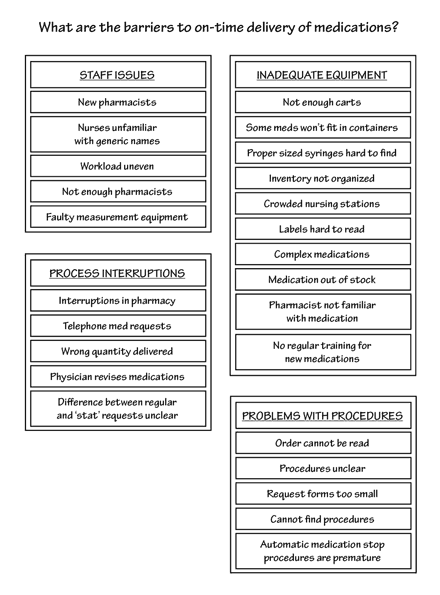
Figure 3 Affinity Diagram On-Time Delivery of Medications
Next Steps: Making Connections to Other Tools
While an affinity diagram may present interesting data and useful ideas, the exercise itself should lead to further analysis. The team can now use a interrelationship diagram, for example, or even a cause-and-effect diagram to get to root causes for late medications.
An affinity diagram, above all, stimulates discussion about a problem or issue, opening up possibilities for improvement or solution.
Affinity Diagram Example #3
Company SQBOK seeks to understand the difficulties around and excessive time needed for onboarding new employees. A team of hiring managers, new employees, human resource managers, and peer employees conducted a brainstorming session and identified 15 problems. In an affinity diagram process, all of the ideas were written down on "sticky" pages affixed to a board.
A separate group charged with managing the onboarding process was asked to identify any commonalities or relationships between the ideas. The group identified four main categories: training, paperwork, regulatory, and technology. Each idea was categorized under these general areas. Company SQBOK can now track these four areas and assign them to the appropriate groups for resolution. The process also highlights areas of deficiency.
Details of this exercise, which highlights improvement opportunities for the team, are shown in the table below.
| Training Paperwork Regulatory Technology |
Orientation is too long Organization charts do not get updated Citizenship establishment process is too lengthy Badges are not returned quickly |
| Training Paperwork Regulatory Technology |
Orientation does not cover office hour access times Request for parking pass should be online Drug testing results not available prior to start System logon access needs to be complete prior to day 1 |
| Training Paperwork Regulatory Technology |
Classes specific to our company are too infrequently offered I4 form difficult to understand Computers are all different models and configurations |
| Training Paperwork Regulatory Technology |
Applications needed for each job are different |
| Training Paperwork Regulatory Technology |
Requirements for a laptop need to be identified |
| Training Paperwork Regulatory Technology |
Badges need access levels established prior to start |
| Training Paperwork Regulatory Technology |
Cell phone policy confusing |
Adapted from The Quality Toolbox, Second Edition, ASQ Quality Press.